Ensure RSC’s Boiler Safety Inspection Program requirements with CLASSIC INDUSTRIAL SERVICE BD

Boiler Safety Inspection & Compliance Services for RMG Factories in Bangladesh

Ensure your factory meets RSC’s Boiler Safety Inspection Program requirements with CLASSIC INDUSTRIAL SERVICE BD—your trusted partner for end-to-end boiler safety, documentation, and audit preparedness.

Why Boiler Safety Inspections Matter

The RMG Sustainability Council (RSC) mandates strict boiler inspections to prevent accidents, ensure worker safety, and comply with international standards (ASME BPVC & Bangladesh Boiler Rules). Non-compliance risks penalties, operational shutdowns, or catastrophic failures.


Our Comprehensive Boiler Inspection Services

1. Pre-Audit Gap Analysis & Documentation Support

We review your boiler systems and paperwork to identify gaps before the RSC audit. Required documents we help prepare:

      •        Registration & Compliance Certificates (renewals, ownership transfers).
      •        Operator Certifications (trained personnel records).
      •        Technical Manuals (design specs, wiring diagrams, steam network maps).
      •         Test Reports (flue gas analysis, water quality, hydrostatic tests).
      •          Maintenance Logs (operation history, repair records (NDT Test report)).

2. Two-Phase Boiler Inspection

     A. Shutdown Inspection (Internal & Hydrostatic Test)

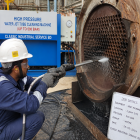
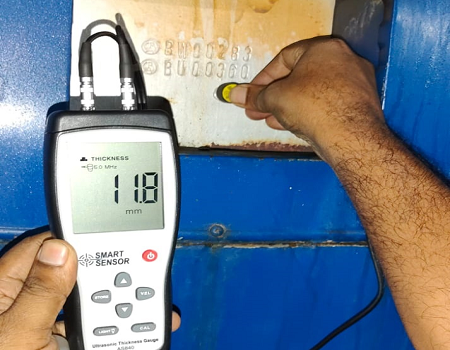
      •      Internal Examination: Checks for corrosion, cracks, scaling, or weld defects.
      •       Hydrostatic Pressure Test: Conducted at 1.5x max working pressure to verify structural integrity.

      B. Operational & Safety Checks

      •       Combustion Efficiency: Verifies proper firing, flame stability, and fuel usage.
      •      Safety Device Testing: Calibrates valves, gauges, alarms, and low-water cutoffs.
      •      Steam System Review: Inspects pipelines, blowdown systems, and feedwater pumps.

3. Corrective & Maintenance Services

      •      Descaling & Cleaning: Removes sludge/scale to improve efficiency.
      •      Repairs & Retrofits: Fixes leaks, faulty welds, or outdated components.
      •      Training: Guides your team on boiler safety protocols.

Industries We Serve

 RMG & Textile Factories
 Pharmaceuticals
 Food Processing
 Chemical Plants
 Any Facility Using Steam Boilers


Why Choose CLASSIC INDUSTRIAL SERVICE BD?

 RSC-Compliant Reports: Avoid rejections with audit-ready documentation.
 Bangladesh Boiler Rule Expertise: Deep knowledge of local regulations.
 End-to-End Support: From pre-audit to post-inspection fixes.
 Fast Turnaround: Minimize downtime during inspections.


Contact Us for a Risk-Free Audit!

 Call/WhatsApp: +8801818271791
 Email: selim@classicindustrialservice.com
 Website: www.classicindustrialservice.com

Don’t wait for penalties—proactively secure your boiler systems today!

# RSC Boiler Inspection Compliance Guide #

RSC Boiler Safety Inspection Program: What Your Factory Needs to Know- Mandatory Compliance for RMG Factories in Bangladesh

The RMG Sustainability Council (RSC) has launched a Boiler Safety Inspection Program to prevent catastrophic boiler failures and protect worker safety. If your factory has been selected for inspection, full participation is mandatory to maintain your partnership with RSC and avoid operational disruptions.

We know The RSC is commencing a Boiler Safety Inspection Program to reduce the risk of potentially fatal boiler failures and to determine how we can support boiler safety in the RMG factories in Bangladesh.

As you have been previously notified by your assigned Remediation Programmed Officer (RPO), your factory has been selected to participate in the Boiler Safety Inspection Program. Your full participation in this inspection program is an integral component of your partnership with the RSC to assure worker safety in your factory.


Prior to the inspection, please ensure that the necessary documentation is available and follow the guidelines outlined below. Furthermore, if any new boiler are installed after the visual inspection date, the relevant documents must Be available on site. The factory shall also disclose the presence or usage of any unregistered boiler or any small boiler with a volumetric capacity of less than 25 liters during the inspection. AII relevant documents should be maintained on-site.

Necessary Documents before Boiler Inspection:

Before the date and time designated for the inspection, please compile the following documentation for review:     ‘

    • Registration certificate, Certificate renewal, Ownership change certificate (if applicable) “
    • Operator
    • Boiler operation and maintenance manual, Manufacturing drawings and calculations (heating serface, maximum pressure, volume capacity, safety valves, ), Boiler electrical wiring diagram.
    • Datasheets of mountings, accessories & feed water
    • Boiler commissioning documents, Diagram of steam distribution
    • Boiler operation & maintenance
    • Flue gas analysis report (not applicable to electric boilers).
    • Feed/Blowdown water test report, Water treatment plant design &


Boiler Inspection will do by Two Part:

Part 1: Internal Inspection & Hydrostatic Test (Shutdown Inspection)

     1.          Internal Inspection

      • Checks for corrosion, scaling, cracks, bulging, or weld defects inside the boiler.
      • Examines water-side deposits (sludge, scale) and fire-side condition (burner area, tubes).
      • Ensures no structural weaknesses in drums, headers, and tubes.
    • 2.         Hydrostatic Pressure Test (Hydro Test)
      • Conducted at 1.5 times the boiler’s maximum working pressure (as per ASME BPVC & Bangladesh Boiler Rules).
      • Verifies leak-tightness and strength under pressure.

 Part 2: Operational & Safety Device Check (Running Inspection)

     1.      Operational Check

      • Verifies proper firing, combustion efficiency, and flame stability.
      • Checks water level controls, feed pumps, and automatic controls.
      • Ensures no abnormal vibrations or overheating during operation.

      2.       Safety Mountings & Accessories Check

      • Safety Valves – Tested for correct set pressure & blowdown.
      • Pressure Gauges – Calibration checked.
      • Water Level Indicators (Gauge glass, low-water cutoff) – Functional test.
      • Blowdown Valves & Fusible Plugs – Operational check.
      • Alarms & Trips – Verified for proper function.
Read More

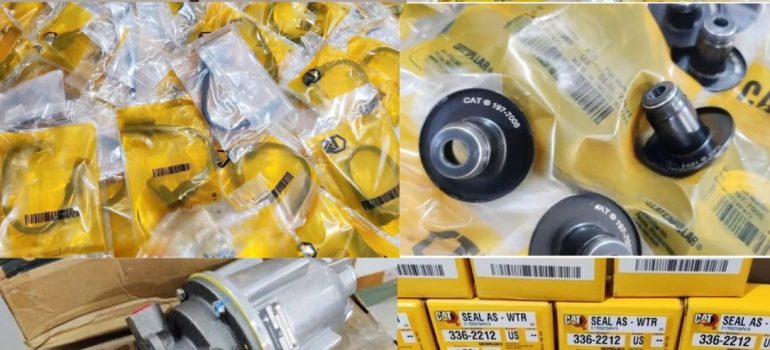
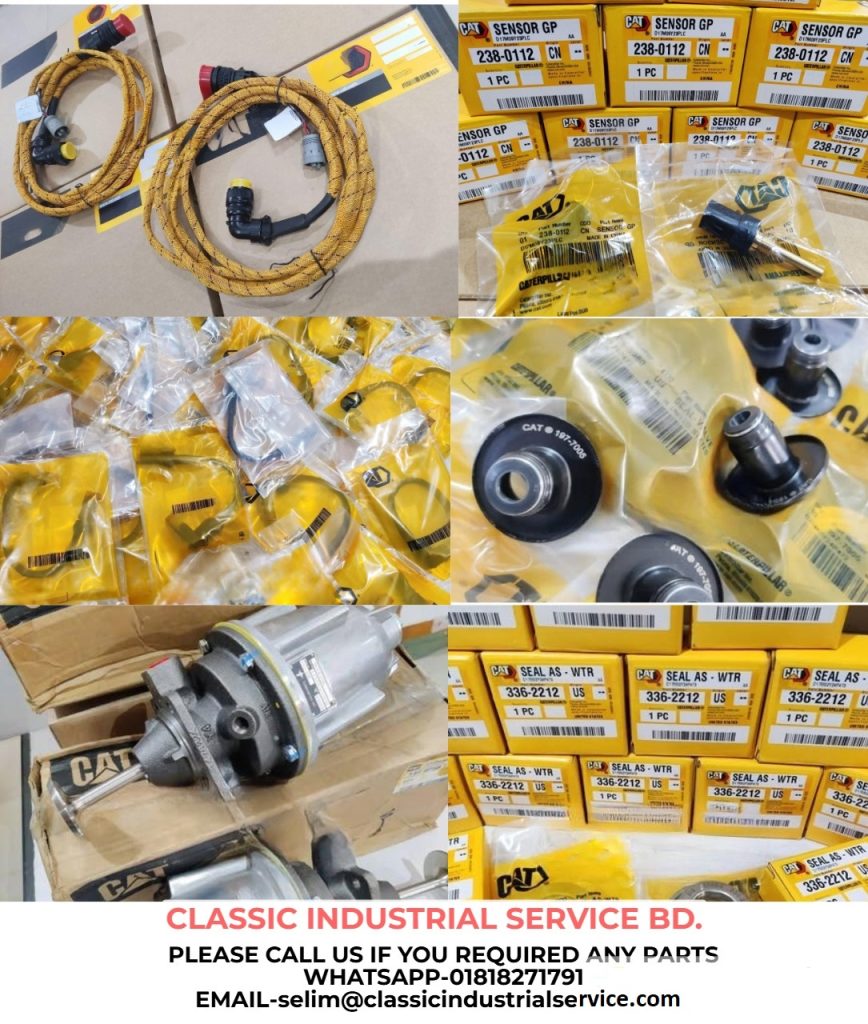
Classic Industrial Service BD are giving prefect & original spare parts support for CAT Engine/Generator.

The Classic Industrial Service BD are giving prefect & original spare parts support for CAT Engine/Generator. Also providing repair & emergency servicing work for your Industries Bangla CAT Generation.

Maintaining your CAT engine is essential for optimal performance. Regular oil changes, filter replacements, and coolant checks can prevent costly breakdowns.

Monitor your engine’s temperature and listen for unusual sounds; early detection of issues can extend its lifespan. Ensure you use genuine CAT parts and follow the manufacturer’s guidelines for maintenance. Keeping detailed service records helps track performance and identify potential problems.

Investing in expert care not only enhances efficiency but also maximizes resale value. Remember, a well-maintained engine is a productive engine!

Please call US now
WhatsApp- 01818271791
Email-selim@classicindustrialservice.com

Choosing original CAT engine spare parts is crucial for optimal performance and longevity. ️From Classic Industrial Service BD store.

#Harness #Sensors #Spark_plug  #Gaskets  #Seals  # Bypass_actuator  #Pump  #CAT_SPARE_PARTS

Quality parts ensure your machinery runs smoothly and efficiently, reducing unexpected downtime. While cheaper alternatives may seem appealing, they often compromise performance and increase maintenance costs over time.
Investing in original CAT parts means fewer repairs, enhanced safety, and better resale value for your equipment.
Remember, quality and affordability go hand in hand when it comes to sustaining your investments. Choose wisely to ensure your operations remain uninterrupted and cost-effective.
When it comes to CAT engine spare parts, quality and affordability are paramount. Our original CAT parts are crafted to meet stringent manufacturing standards, ensuring optimal performance and longevity. ️
While many suppliers offer cheaper alternatives, they often compromise on quality, leading to increased maintenance costs over time.
Our competitive pricing doesn’t mean we sacrifice excellence; it means we provide reliable solutions that keep your machinery running smoothly.
Investing in authentic parts means fewer breakdowns and increased productivity. Trust us for your CAT engine needs.
We are focus on used gas generator / Gas & Diesel Engines- MWM-DEUTZ & CAT. These are very good condition, overhauled,
low running hour, complete accessories and competitive price. We are ensuring commissioning after priority service and maintenance
24 X 7 hours, spare parts to our valuable customers in Bangladesh and all over the world.
We work this model: TCD2016V12, TCD2016V16, TCD620V12, TCD620V16, TCG2015V08, TBG616V12, TBG616V16, TBG620V16K, TBG620V12K,
TBG604V08, TBG604V12, TBG632V12, TBG632V16, TCG2016V12, TCG2016V16, TCG2020V16K, TCG2020V12K, TCG2032V12, TCG2032V16, TCG3016V12,
TCG3016V08, TCG3016V16, TCG3016V16.
CAT#CG132B8, CG132B12, CG132B16, CG170-16, CG170-20, CG260-12, CG260-16.
Read More

Use Biomass Boilers Reduced carbon Footprint

The term “ biomass boilers ” refers to all boilers and systems powered by fuels of organic origin, i.e. waste, residues and industrial and urban waste of vegetal or animal origin that can no longer be reused, but which can be transformed into electrical energy and heat.

As defined by the European Directive 2009/28/EC, biomass is “ the biodegradable fraction of products, waste and residues of biological origin from agriculture (including vegetal and animal substances), forestry and related industries, including fishing and aquaculture, as well as the biodegradable fraction of industrial and municipal waste ”.

Biomass and the fuels derived from it represent a renewable energy source, since the carbon dioxide they emit during the combustion process is more or less the same as that which plants absorb during their life and release once they die. The combustion of biomass does not therefore lead to an increase in carbon dioxide in the atmosphere, the main cause of the greenhouse effect, but rather constitutes a further advantage for the environment given the biodegradability of the substances that are burned.

Our boilers are designed to burn both biomasses now considered commonly used, such as wet wood chips and pellets, and biomasses derived from organic waste such as sawdust, briquettes, bark, chicken manure, mushroom beds, miscanthus, nutshells, peat, CDR, vine shoots, pomace, grape marc.
For specific fuels we require a chemical analysis, on the basis of which we can then design a customized system.
The disposal of industrial processing waste has a significant impact on company costs. Biomass systems allow waste to be transformed into a resource, obtaining electrical energy and heat from its combustion.
The biomass systems we design are suitable for any type of industrial process and comply with pollution regulations. The boilers can be built with “water jacket” technology, which allows for smaller dimensions and higher yields, but are also available with an adiabatic chamber. We supply complete systems, from the storage/feeding system, transport, combustion and fume filtering.
We follow and support our customers in every phase of the project, from the choice of the machine to the commissioning.
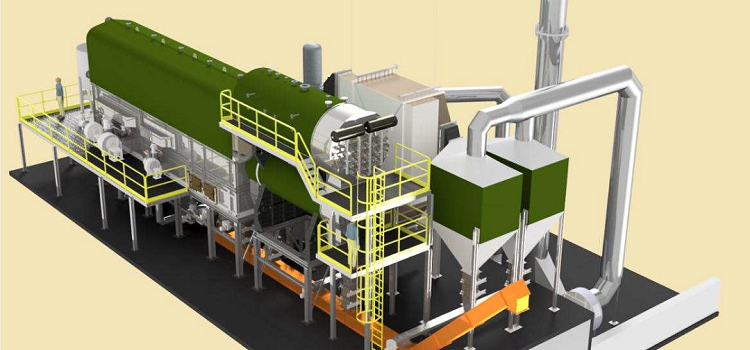
Usually the plant is divided into various sections of which the main ones are:

  1. Storage silo
  2. Power system
  3. Water heater
  4. Combustion grate
  5. Filtering
  6. Fireplace  


  1. Storage silo

The storage silo is the part of the plant where the biomass is stored, to then be moved and transported to the feeding system.
We can create different types of storage silos depending on the characteristics of the fuel and the customer’s needs.

  1. Power system

From the storage silo the biomass is transported to the boiler and poured onto the combustion grate through the feeding system. The latter is generally made up of one or more augers or a chain conveyor (or both), designed to ensure the necessary supply of fuel to the boiler.
The system is designed in compliance with safety and fire prevention regulations.

  1. Water heater

Biomass boilers consist of a combustion chamber and a heat exchanger.
The combustion chamber is equipped with fans for air supply and probes for combustion parameter control. The chamber can be adiabatic or wet chamber. Combustion, which can take place on a fixed or mobile grate, produces hot fumes that go into the heat exchanger, and ash as waste. The ash can be collected either with automated systems or manually.
The heat exchanger uses the energy of the fumes to produce hot water, superheated water, steam, etc., depending on the type of system selected. All safety accessories and the system for automatic exchanger cleaning are generally included in the supply.
Our boilers are built in compliance with the latest regulations and can be certified according to ASME, PED, etc.

  1. Combustion grate

The grill or brazier is the area where the material for combustion is poured. There are 3 types of grills:

  • Fixed flat
  • Flat furniture
  • Inclined mobile

The flat fixed grate is the simplest; it is an economical system that requires regular manual cleaning of the ash.
The mobile grates are used for medium-large sized systems and are equipped with systems for automatic ash expulsion. This type of grate allows control over the progress of combustion, thus ensuring greater efficiency.

  1. Filtering

The fumes at the exchanger outlet must be “cleaned” and, generally, two systems are used for this purpose (separately or together):

  1. Cyclone (or multi-cyclone) filters for initial filtering that complies with the main pollution regulations;

  2. Bag or electrostatic filters for superior filtration

  1. Fireplace

After filtering, the fumes are pushed by the tail fan through the chimney and expelled into the atmosphere.
Other components may be present in a biomass plant depending on the characteristics of the fuel and the customer’s requests; correct initial design is essential to prevent possible future inconveniences.

BIOMASS PLANTS

The use of biomass has ancient origins, wood has always been burned for heating and cooking. Today, individual consumption has developed on a large scale, adapting to the most varied industrial applications.
Modern power plants are able to exploit the energy contained in biomass to produce hot water, superheated water, steam and electricity, reducing the environmental impact to a minimum compared to non-renewable energy sources.

Hot water

For water temperatures below 110/115°C, hot water boilers are used. The most common uses are in the central heating sector of hospitals, greenhouses, industrial warehouses, etc. Thanks to the simplicity of the system and the undemanding management, hot water systems are preferred to others within the limits described above.

Superheated water

For water temperatures above 110/115°C, superheated water boilers are used. The most common uses are in the district heating sector and specific industrial applications (food, manufacturing, etc.). This type of system is also used in cogeneration plants.

Steam

Our range of biomass boilers includes biomass steam generators (saturated or superheated). Applications range from industrial (food, pharmaceutical, etc.) to electricity generation with steam turbines.

Cogeneration and trigeneration

The term “cogeneration plants” refers to those systems that allow the combined production of electricity and heat. When we talk about trigeneration, we are referring to systems that can produce three distinct forms of energy: electricity, heat and cooling.
We can provide turnkey cogeneration and trigeneration plants.

Boilers

Model Typology Minimum potential Maximum potential
GPT – AC Smoke pipes, 3 turns, hot water production 900 kW 9000 kW
GPT – AS Smoke pipes, 3 turns, superheated water production 900 kW 9000 kW
GPT – CP Smoke pipes, 3 turns, steam production 1000 kg/h 12000 kg/h
GPT – HA Smoke pipes, 3 turns, hot air production 400 kW 1500 kW
GPT – PW Cogeneration 50 kWe 5000 kWe
Standard boiler data Design pressure Boiler room dimensions (mm) Potential Maximum weight with water (kg)
GrillGF-P GrillGF-M30 GrillGM-M30 Grill

GM-M50

1200 GPT/AC 6 bars
10 bars
8000×5000 H.4200 9000×6000 H.4500 9000×6000 H.4500 9000×6000 H.5000 1200 kW 18,800
GPT/AS 8000×5000 H.4350 9000×6000 H.4650 9000×6000 H.4650 9000×6000 H.5150 1200 kW 18,800
GPT/CP 8500×6000 H.5880 8500×6000 H.5880 9000X6500 H.5960 9000X6500 H.6520 1860 kg/h 23,800
1650 GPT/AC 6 bars
10 bars
8500×6000 H.4200 8500×6000 H.4500 9500×7700 H.4500 9500×7700 H.4800 1650 kW 26.100
GPT/AS 8500×6000 H.4350 8500×6000 H.4650 9500×7700 H.4650 9500×7700 H.4950 1650 kW 26.100
GPT/CP 9500×7000 H.6420 9500×7000 H.6420 9500×8000 H.6500 9500×8000 H.7100 2560 kg/h 30.800
2100 GPT/AC 6 bars
10 bars
10000×7500 H.4600 10000×7500 H.4900 9500×8500 H.6000 9500×8500 H.5700 2100 kW 35.800
GPT/AS 10000×7500 H.4750 10000×7500 H.5050 9500×8500 H.6150 9500×8500 H.5850 2100 kW 35.800
GPT/CP 9500×8000 H.7145 9500×8000 H.7145 9500×9000 H.8270 9500×9000 H.8270 3255 kg/h 43.300
3000 GPT/AC 6 bars
10 bars
11000×8500 H.5500 11000×8500 H.5800 11000×8500 H.5800 10500×8500 H.6947 3000 kW 50.800
GPT/AS 11000×8500 H.5650 11000×8500 H.5950 11000×8500 H.5950 10500×8500 H.7097 3000 kW 50.800
GPT/CP 11000×9000 H.8200 10500×9000 H.9450 10500×9000 H.9530 10500×9000 H.9450 4650 kg/h 60,000
The following special models are also available:
• 7000 with potential 7000 kW 10850 kg/h
• 9000 with potential 9000 kW 12000 kg/h

Standard design pressures from 6 bar to 25 bar – Higher design pressures available on request. .

For any requests for special models and applications and/or different from those in the catalogue, a feasibility analysis must be carried out.

Grids

Model Typology Minimum potential Maximum potential
GF – P Fixed pellet grill 900 kW 3000 kW
GF-M30 Fixed grid for wood chips maximum humidity 30% 900 kW 3000 kW
GM – M30 Mobile grate for wood chips maximum humidity 30% 900 kW 9000 kW
GM – M50 Mobile grate for wood chips maximum humidity 50% 900 kW 9000 kW
Read More

May Inspiration: Beautiful and Creative PU Flooring & Epoxy Flooring

PU Flooring In Bangladesh

PU Flooring in Bangladesh is a solo suite product that proposing a variety of surface profiles plus performance specifications. Classic Industrial Service BD providing these services for PU Flooring in Bangladesh as the best applicator as well as a contractor at affordable prices. We are also providing the best services for Epoxy Flooring, Floor Hardener, Polished concrete, Vinyl flooring, Roof top Waterproofing in Bangladesh. In the concept of Industrial & Commercial Flooring System, the abbreviation of PU Flooring in Bangladesh is Polyurethane Flooring. Due to the formulation of this flooring supplies in process of Polymer reaction of a portion of the Polymer Chemistry.

Nowadays PU Flooring service in Bangladesh is growing to the international level which is much value for real life. People who want to take those kinds of service. PU Flooring in bd has the most power deciding the PU floor need to consider easy to clean and point loading traffic from more equipment before doing the heavy pallet trolley and fork-lift water with a proxy place.

Classic Industrial Service BD offered you to get permanent solution for Industrial & Commercial building flooring in Bangladesh. The flooring that we offer is cost-effective and sturdy too and that is why we have gained a reputed stature in the market. Classic Industrial Service BD is sure to serve our customers for a long period of time.

Read More